Vulcan Rocket Fails Ten Minutes In, Destroying 40 Amazon Leo Satellites
Seven Lights
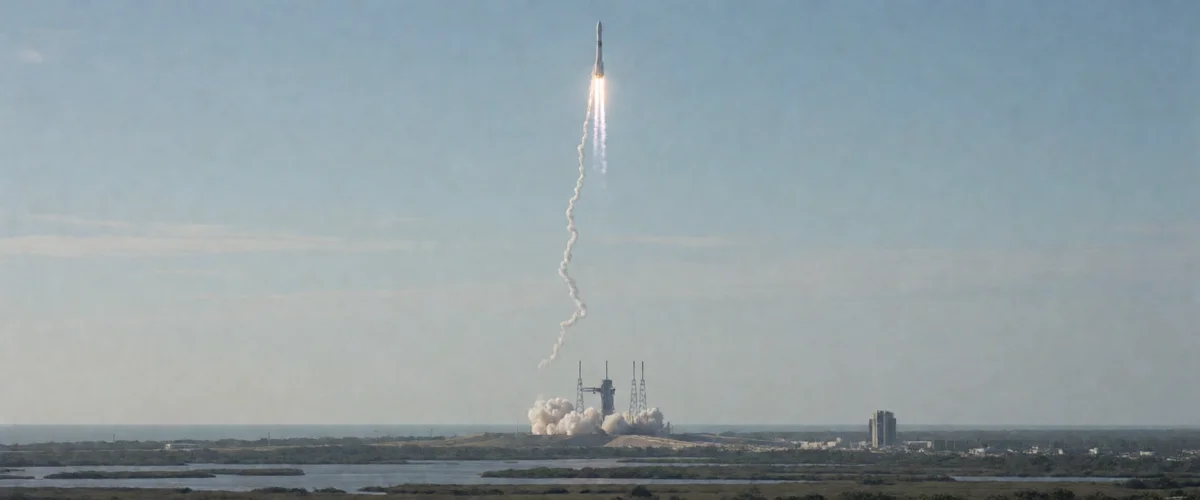
A United Launch Alliance Vulcan rocket was lost ten minutes after liftoff Sunday from Cape Canaveral, destroying the 40 Amazon Leo broadband satellites aboard — the first total mission failure in the alliance’s 20-year history.
The rocket left Space Launch Complex 41 at 12:40 p.m. Eastern, after a refuelling problem scrubbed an attempted launch on Friday. ULA said in a statement that the vehicle “suffered an anomaly” 10 minutes into the flight and failed to reach orbit. The six strap-on solid rocket boosters, which had caused failures on two of Vulcan’s four earlier flights, separated on time and performed normally. Multiple sources told Ars Technica the anomaly occurred in the booster stage rather than the Centaur V upper stage.
Telemetry shown on ULA’s broadcast indicated the booster’s two methane-burning BE-4 engines, made by Blue Origin, burned past their planned shutdown just short of the five-minute mark — an overburn that can indicate a stage is underperforming. The rocket began to spin moments after booster engine cutoff and continued to spin through separation of the upper stage. The Centaur’s RL10 engines ignited and vectored thrust in an apparent attempt to put the vehicle back on course. ULA ended its broadcast minutes later without discussing the anomaly and declared the mission a failure, saying it had no immediate data on the cause. Engineers will review the flight, and the rocket faces an indefinite grounding.
The loss strikes Amazon twice. Its Leo constellation is the first head-to-head rival to SpaceX’s Starlink in consumer satellite broadband. It has fewer than 400 satellites in service against a Federal Communications Commission requirement for 1,600 by July 31, 2026, a deadline Amazon has already missed, and a planned first-generation network of more than 3,200 spacecraft. Sunday’s launch was the first of 38 Vulcan flights Amazon has booked after eight Atlas V missions. Amazon said ULA “has been a trusted partner” and that it believes the alliance will “learn from this mission.”
For the US government, the grounding carries weight beyond commerce: ULA holds contracts to fly roughly half of the military’s national security space launches. Amazon officials said in October that enough satellites were in orbit to begin initial commercial service by the end of this year. Sunday’s failure widened the launch backlog standing between that start and the network’s planned scale.