Hera Finds Stadium-Sized Crater Left by DART on Asteroid
Seven Lights
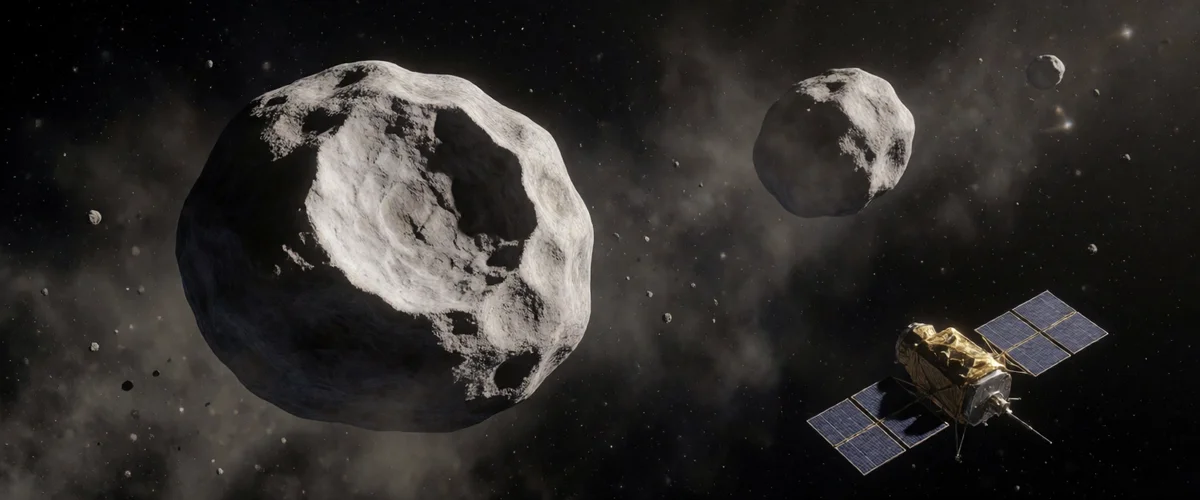
The European Space Agency’s Hera spacecraft has photographed the aftermath of NASA’s 2022 DART impact on the asteroid Dimorphos, finding a flattened crater the size of a sports stadium that spans the width of the 151-meter body.
Hera’s principal investigator, Patrick Michel of France’s CNRS, said scientists had debated whether the collision left a crater, changed the asteroid’s shape, or produced neither. “Much to our surprise the answer turns out to be all three at once,” Michel said. “The face struck by DART has been flattened into an impact crater the size of a sports stadium, which extends across the asteroid’s entire width.” The boulder-strewn fields covering the rest of the surface were unchanged.
The images also show that the impact set Dimorphos tumbling in its orbit, and that hundreds of boulders now orbit both Dimorphos and its larger companion, the 730-meter Didymos. NASA’s DART spacecraft deliberately struck the asteroid in September 2022; tracking soon confirmed the orbit had shifted, but the effect on the asteroid itself was unknown until Hera arrived.
“NASA’s DART mission demonstrated that we can change an asteroid’s orbit,” Hera mission manager Ian Carnelli said. “Hera is now revealing what happened to the asteroid itself. By combining these two missions, humanity is taking a decisive step towards making asteroid deflection a reliable tool for protecting our planet.” Space agencies regard orbit alteration as the leading method for diverting a hazardous asteroid.
Hera has surveyed the pair from 25 to 30 kilometers, tracing rectangular paths with thruster firings rather than conventional circular orbits, at a crawl of roughly 12 centimeters a second. In December the agency plans to bring the spacecraft to about 13 kilometers for higher-resolution images of the impact site. Mission scientists Michael Kueppers noted the team “will have to take account of” the orbiting boulders as it moves in closer.
Early in 2027 Hera is to release two shoebox-sized CubeSats. Juventas, built by a Luxembourg-led team, will use radar to probe the interior and attempt a landing; Milani, led by Italy, will study surface composition and surrounding dust. Measuring Dimorphos’s mass, combined with the observed orbital change, will let scientists judge how effectively DART transferred momentum.